How My First EDM Track Unretired Me from Game Development
By November 2025 I considered myself retired from game development. Then a friend dropped my techno track into a silent prototype, and that prototype became Lucky Shot.
1. Breaking Myself Before Making Myself
By November 2025, I considered myself officially retired from game development. It had been two full years since I last touched a game engine, and to be completely honest, retiring was not really my decision. I had just failed miserably.
Back in 2022, I landed what was supposed to be my dream job at Buldogo Games: well-paid, working full-time as a game developer. The reality was that I did not perform well and could not fit properly into the team. Even when Jorge Lorenzon, Buldogo’s owner, generously offered to lower both my pay and the expectations so I could stay on, I decided to resign. I knew I needed to grow, and sometimes you have to break yourself before you can make yourself.
The two years that followed were brutal. In the first year, I tried to land another job as a Unity developer, but I was terrible at interviews, and most companies straight-up ghosted me. By the second year, I went through the most traumatic technical interview of my life. After that, I decided to stop accepting interviews that only led to tech leads treating me like I was a second class citizen in this industry.
Little by little, I was pushed out of the market. Despite my best efforts, I could not even land a general software development job outside of games. I went back to college hoping to learn and reset (which did not really do much) while surviving on freelance audio work, mixing and mastering songs for pennies. Looking back, I realized that traditional employment was a dead end for me. My only real way forward was entrepreneurship. I just needed the right vehicle.
2. Smash Bros., Buenos Aires Nights, and "Tech in Place"
Around that same time, I was going out to parties in Buenos Aires a lot. The city's nightlife got into my head, and while I had always liked electronic music, I started getting much deeper into EDM and techno. That led me to produce and release a techno track totally outside my usual style.
I called it "Tech in Place", named after the recovery mechanic in Super Smash Bros., which happens to be the exact reason I knew Tomás in the first place.
Back in 2019, Tomás was the best Argentinian Super Smash Bros. Melee player (he’s still the GOAT, kids these days have to be grateful he retired) and was raising funds to fly to New York to compete. He made a Reddit post looking for a sponsor, and I replied to send my support. In February 2020, right before the world locked down, we finally met in person at a local tournament. Soon after, we entered the online Smash Ultimate era. He started streaming, I was always in his chat, and by the time the lockdown lifted in 2021, Tomás, a few other guys, and I started hanging out in real life. We barely even played Ultimate anymore; we had just become genuine friends.
3. EVA 2025, Raw Fury, and Going All In
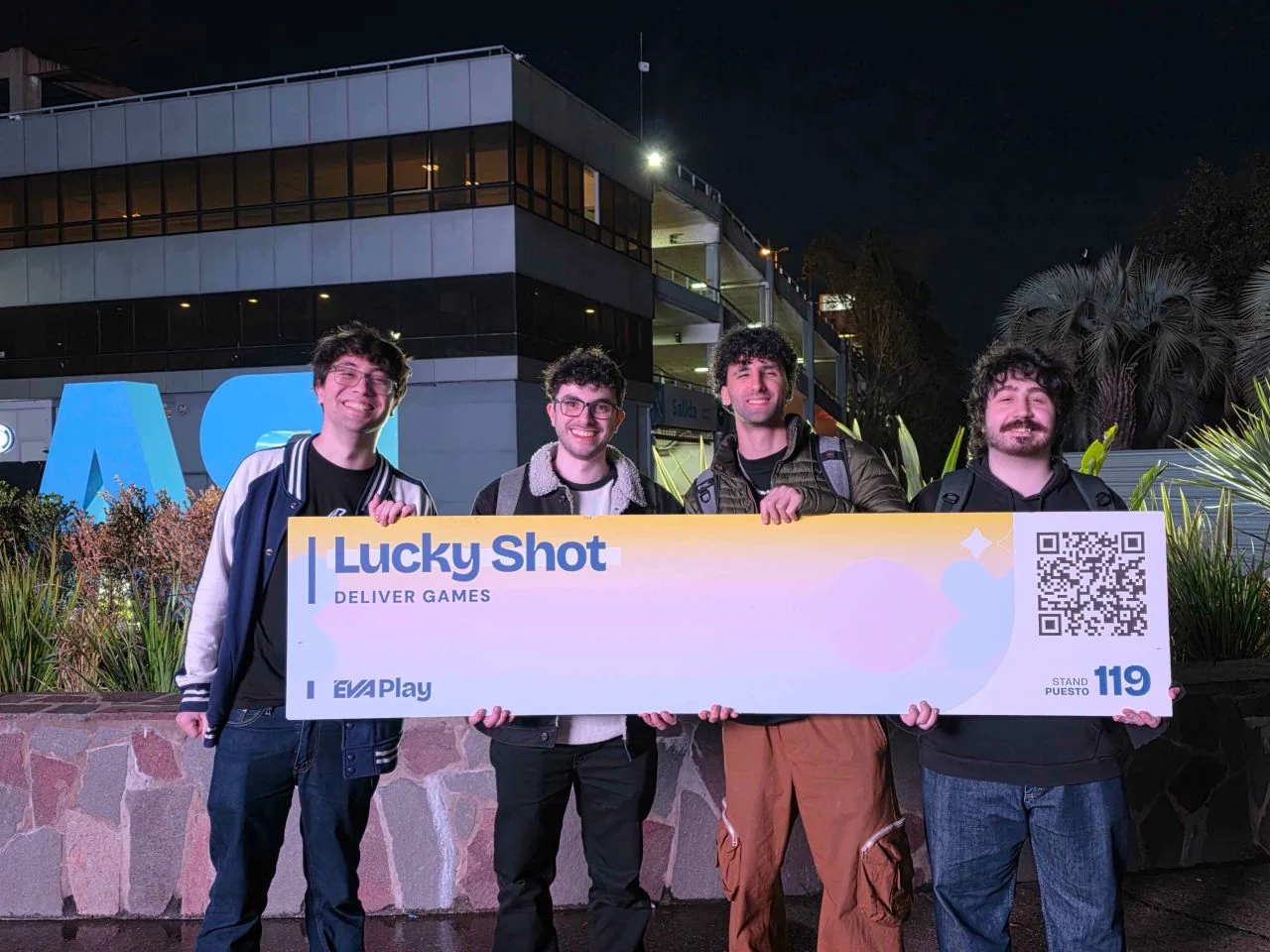
Fast forward to November 2025, Tomás came to Buenos Aires to give a talk at EVA (Exposición de Videojuegos Argentina). While he was in town, he had another mission: pitching a rough MVP of a new game to Raw Fury.
There was just one problem. His prototype was completely silent, and he was out of time. Between his deadline and the fact that I had just released an upbeat techno track named after a Smash Bros. mechanic, the solution was right in front of us. He grabbed "Tech in Place" and threw it into the build to fill the dead air. That frantic prototype was the earliest version of Lucky Shot.
The pitch to Raw Fury went okay, though it ended up landing nothing. Still, the positive feedback around the prototype at EVA was enough to get all of us hyped. We decided right then and there to go all in. Lucky Shot was coming out with or without a publisher, and Tomás offered me a spot at Deliver Games to chase glory together.
On paper, the deal was simple: I was only joining to make the music and sound effects.
I just could not help myself.
4. "Just the Audio Guy" (Who Refactored the Codebase)
The moment I opened Unity again after two years away, everything that had been missing in me came rushing back. It is wild to think that this happened less than a year ago, because it already feels like a lifetime. Everything in my life, and the world, changed over these past twelve months.
When I first looked under the hood of the project, there was basically no architecture. Tomás had been sprinting to hit an impossible deadline (which, to be fair, is just how we roll), and the codebase was a wild west where classes had names pointing to data when they were actually handling behavior.
I have always cared deeply about clean code and design patterns (Rest In Peace). To me, good architecture is not just about optimization; it is about having clear patterns so the whole team can work in harmony. At first, I stayed in my lane and started integrating Wwise to build out the SFX and music systems. But the second those audio systems needed to communicate with the actual gameplay, I had no choice. I rolled up my sleeves and started putting the codebase in order.
Even "Tech in Place" had to be refactored. As cool as the original EDM track was for a club, it made zero sense inside a game because it lacked the interactive music DNA that Lucky Shot needed. Still, we loved the tone of the track. So I kept the original drum kit, bass, and pads, tore the structure apart, and rebuilt it with reactive layers. That club track evolved into "LuckyOS" (or "Lucky Tech in Shot"), the very first official world theme of the game.
What started as "just adding sounds and music" snowballed until I became one of the core pillars of the project. At some point, I had my hands in so many different systems that I actually became a bottleneck for the team. How we got past that roadblock together is a story for another day.
5. Burning the Boats and Finding the Signal
To focus 100% on Lucky Shot without taking another job, I literally burned through all of my savings. It was a terrifying bet after two years of rejection.
Then the game launched. In the very first week, I made $3,000 USD for myself. I had not made that kind of money in so long that I felt like I had been reborn. Right now, I can actually survive off our game, which means I hit my personal goal.
More importantly, the numbers gave me the validation I had been chasing for years. As a studio, we spent $18,000 on development (most of it going toward marketing) and ended up making $33,000 in profit. There are plenty of nuances to unpack, and I am still quantifying the full scale of what we pulled off, but that kind of return is an undeniable market signal that we did the right things. Never in my life have I been more successful than I am right now.
Looking back, I know I shaped Lucky Shot a lot, but Lucky Shot shaped me much more. Thanks to this game, I recovered my faith in myself. In my next devlog, I will break down how "LuckyOS" and the rest of the soundtrack actually work under the hood, track by track. As for me, I finally got the signal I always lacked: I know for sure that this is what I was made for, and it is the career I am going to pursue until I am too old to even turn on my PC.